

Photo: “Symphony Hall (Phoenix, Arizona)” by Visitor7, via Wikimedia Commons, licensed under CC BY-SA 3.0.
The financial crises at the Phoenix and Nashville symphonies illustrate a fundamental problem: established business models are remarkably resistant to change.
On October 20, the Phoenix Symphony announced that it would suspend the remainder of its 2026–27 season following its November 1 performance.
Musicians will be laid off beginning November 2. The organization has not established a date for resuming performances.
Just three weeks earlier, the Nashville Symphony announced a similar suspension, citing a $10 million deficit in its current operating budget. A subsequent $10 million gift from Oracle allowed the orchestra to reverse that decision and resume its season.
These are different institutions, facing different circumstances.
But the striking similarities—and timing—of these two crises raise a question that deserves attention across the arts sector:
Why do performing arts organizations struggle to change their business models, even when the world around them has changed dramatically?
In my inbox, on LinkedIn, and in article comments, I've seen variations of the same question: How did things get this bad? Why couldn't these organizations turn things around before reaching a crisis?
It comes down to how a business model works.
When financial improvements aren't enough
According to the Phoenix Symphony’s financial records, the organization increased its annual revenue by approximately 18% between fiscal years 2024 and 2025.
It also reduced its annual revenue-expense shortfall by nearly $1 million.
Despite those improvements, the organization continued to face substantial financial pressures, culminating in the suspension of its 2026–27 season. The difference this year? Contributions fell short of expectations, and years of accumulated deficits had depleted the financial cushion that previously allowed the orchestra to continue operating.
We see this across the arts sector: Arts organizations are experimenting with ways to improve their offerings, increase revenue, and operate more efficiently. But those efforts don't necessarily change the business models on which they depend.
Improving the financial performance of an existing business model and changing the business model itself are two different undertakings. The Phoenix Symphony's board acknowledged this distinction in its October 23 statement:
"We recognize that the Board must now demonstrate how it intends to resolve the underlying financial problems, rather than simply find enough money to continue operating under the same model."
Once a crisis arrives, recognizing the need for a different business model is the easy part. Changing one that's been built and refined over decades is a whole lot harder.
The business model is designed to preserve itself
In their landmark Harvard Business Review piece, Reinventing Your Business Model, Mark Johnson, Clayton Christensen, and Henning Kagermann examined why established models are so difficult to change.
According to their framework, every business model has four interconnected parts (adapted slightly here for nonprofits):
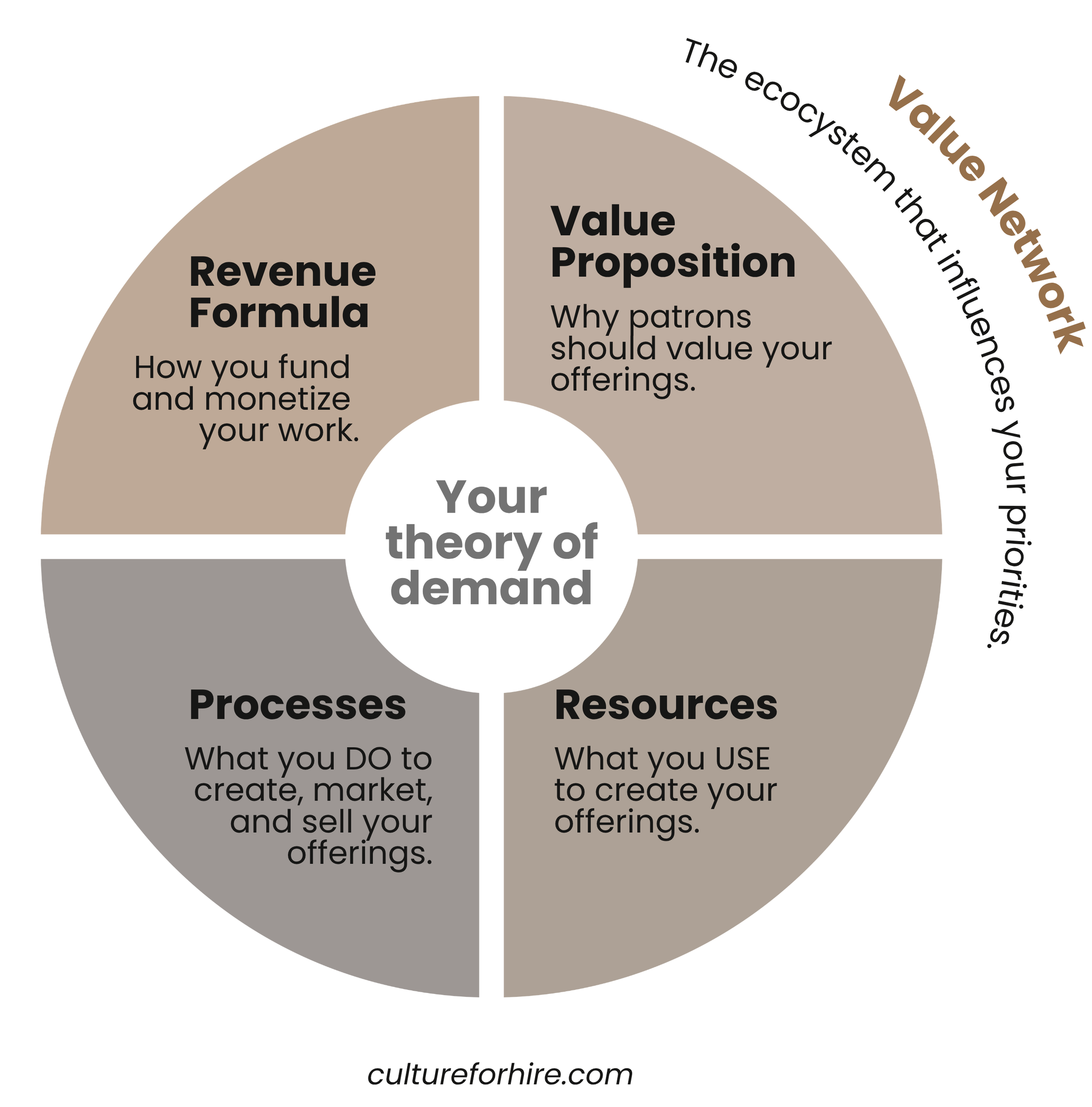
Value proposition: The outcome an organization promises to deliver to its customers—a solution to a problem they’re trying to solve or a need they’re trying to meet.
Revenue formula: How the organization generates sufficient revenue to sustain itself while delivering that value.
Resources: The people, products, technology, facilities, and other assets required to deliver the value proposition.
Processes: The routines, workflows, and decision-making practices that allow the organization to operate consistently.
These elements operate within a broader value network of funders, boards, partners, and industry institutions whose expectations influence organizational priorities.
The authors are clear about where a successful business model begins: with a customer who has a problem that needs solving. The more precisely an organization’s value proposition solves that problem, the stronger it is. Every other element of the model exists to deliver on it.
Beneath the value proposition sits an organization’s theory of demand: its assumptions about why people choose to buy what it offers. When those assumptions start with the product instead of the customer’s “job to be done”, the entire model gets built from the wrong starting point.
Here’s why change is so hard: Over time, these parts become increasingly dependent on each other. Resources are selected to support established processes. Budgets reflect established priorities. You hire people who are good at the way you already work. Marketing reflects your theory of demand. Performance measures reward particular outcomes.
This is how organizations become efficient and reliable.
When the business model is well aligned with market conditions, that interdependence is a tremendous advantage. But when market conditions change, the same system can become an obstacle to adaptation.
An organization may identify a new opportunity without fully investing in the resources required to pursue it.
It may acquire new capabilities without changing the processes needed to put them to use.
It may introduce a promising initiative that conflicts with established financial incentives.
It may adopt an ambitious new strategy while continuing to evaluate success according to criteria inherited from the previous one.
The rest of the business model hasn't caught up.
When a new strategy conflicts with the incentives and priorities embedded in the existing business model, the organization is pulled back toward the behaviors the existing model continues to reward.
What this looks like from the outside: A frustrating cycle of promising initiatives that never lead to lasting change.
Changing the model means starting with demand
Consider the traditional symphony orchestra.
Its resources include highly trained musicians, artistic leadership, performance facilities, production infrastructure, and specialized administrative expertise.
Its processes are built around planning seasons, selecting repertoire, rehearsing, marketing concerts, and maintaining artistic standards.
Its financial model often depends on a combination of ticket revenue, subscriptions, philanthropy, and investment income.
Its value network includes donors, foundations, sponsors, board members, and industry stakeholders who may hold longstanding expectations about programming, artistic achievement, and institutional identity.
These elements work together to produce something extraordinarily valuable: live orchestral performances of exceptional quality.
But what happens when an orchestra continues to produce exceptional performances but faces declining reserves, persistent deficits, and mounting pressure to attract new audiences?
Johnson, Christensen, and Kagermann describe a handful of circumstances that call for a new business model. One of them describes the arts sector almost exactly: an industry organized around its products, where no one has yet built a model around the problems customers are trying to solve.
Building that kind of model is how an orchestra can expand its market beyond people who already value orchestral music. And reaching those potential audiences requires the organization to reconsider what drives demand for the arts.
Are we still assuming that people will attend because the art itself holds a valued position in society? Or are we beginning with the outcomes people seek in their lives—and exploring how an arts experience could help them achieve those outcomes?
When that underlying theory of demand changes, the other parts of the business model must change to support it: the value proposition, resources, processes, revenue formula—even the value network in which the organization exists.
The cost of preserving the familiar
Scott Anthony, author of Epic Disruptions, recently shared a fascinating observation about BlackBerry and Kodak.
In April 2008, just months after the iPhone launched, BlackBerry's revenues had tripled and its stock was up 70%. Its co-CEO was confident about the company's future.
Kodak faced a similar dilemma. The world was saying digital photography was the future, but film sales were continuing to climb.
Anthony calls this the information-action paradox: By the time the data makes the need for change obvious, the opportunity to act may have narrowed dramatically.
“The real job of a leader,” he writes, “is to act on the early, ambiguous signals while the numbers still say everything is fine. That is deeply uncomfortable. It is also the whole game.”
There's an important lesson here for arts organizations.
Financial performance can improve even while the assumptions underlying a business model become increasingly disconnected from consumer reality. And those improvements can make the need for fundamental change harder to recognize.
But organizations don't have to wait for a financial crisis to challenge those assumptions. They can begin examining whether their assumptions about demand still reflect how people make decisions today. And they can use what they learn to identify new markets, rethink their value proposition, and adapt the resources, processes, financial incentives, and relationships needed to serve those markets.
The work is difficult. It requires questioning longstanding assumptions, making different investments, and changing how decisions get made. And the existing model will resist it at every step.
The answer is to build the new model apart from the core business, where established processes and metrics can’t pull it back toward familiar behaviors. For an arts organization, that usually means launching a pilot with its own resources, processes, and definition of success—then collecting the data to build support for that new model across key stakeholders.
The earlier an organization begins, the more freedom it has to shape its own future.
What might a new model look like?
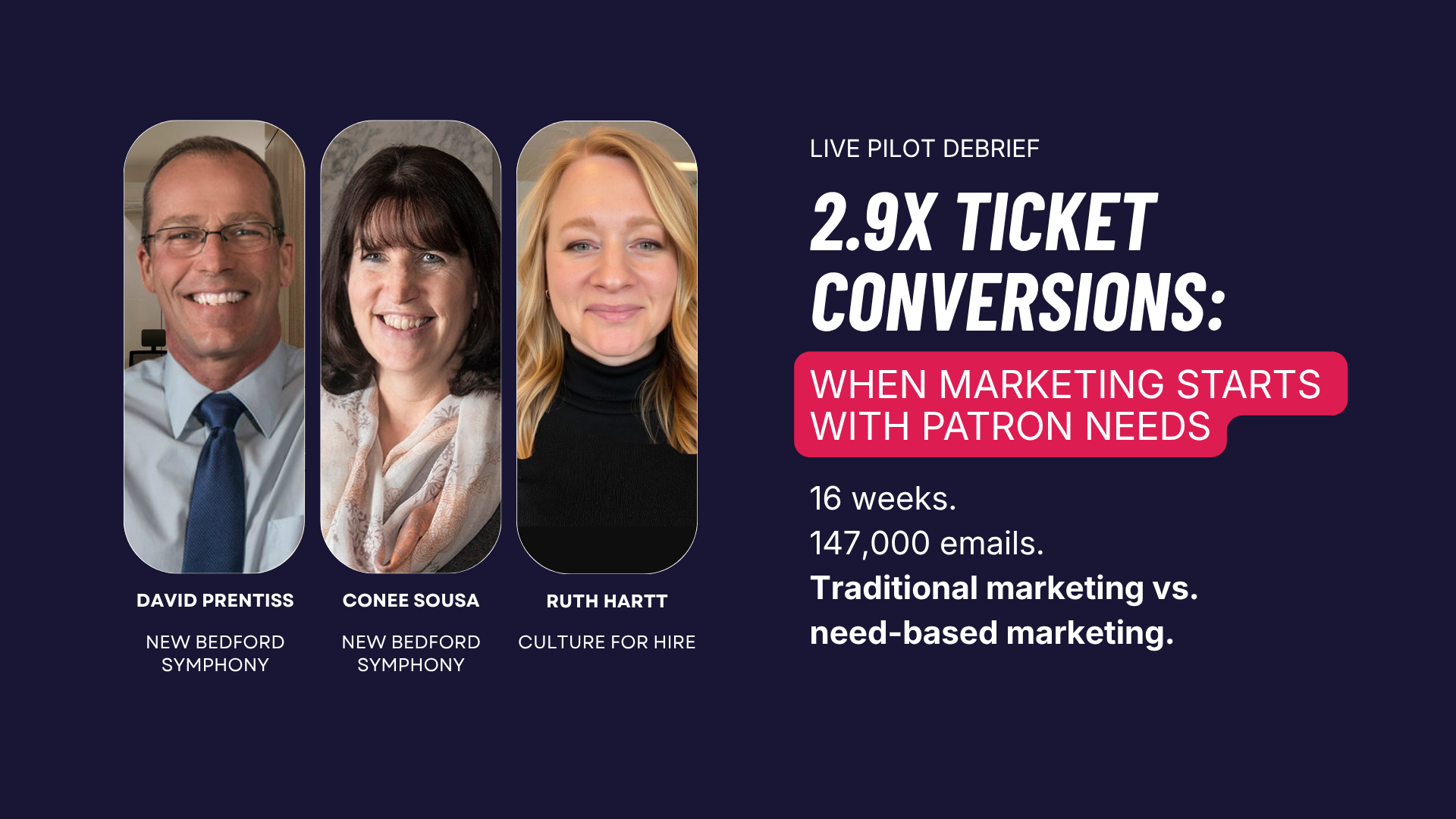
Learn how the New Bedford Symphony tested a new theory of demand—and saw 2.9× more ticket conversions.
