
2.9x Ticket Conversions: When Marketing Starts with Patron Need
Starting in January 2026, the New Bedford Symphony Orchestra ran a 16-week controlled pilot across four concert cycles to test a single question:
Can need-based intelligence increase engagement and drive higher ticket sales?
NBSO is a century-old regional orchestra serving one of the most diverse cities in New England. Under President & CEO Dave Prentiss, the organization has quintupled its concert output, expanded its education work to 45 elementary schools, and grown its budget substantially — all by asking what the community actually needs and trying to deliver on it.
That made NBSO a fitting partner for a pilot that ended up producing 2.9× more ticket conversions than the traditional approach. And the conversions turned out to be just the beginning of what we found.
Supply-side vs. demand-side.
For decades the arts have asked: how do we create demand? The better question is: what are people already seeking that our work can meet?
The arts sector has operated in a supply-side model for decades. We make excellent art. We put the word out. We trust that people will see its inherent value. The supply-side question is always: how do we create demand? The answers usually look inward — better programming, broader outreach, more accessible pricing.
The demand-side model asks a different question: what are people already seeking, and how does what we offer meet that need?
Demand doesn't have to be created. It already exists — in loneliness, in burnout, in the need to put the phone down and be present.
Calm, the meditation app, is a useful example. Calm doesn't tell you how amazing meditation is. The first thing it asks is, "What can we help with today?" By the time you create an account, Calm already knows the need you're trying to solve — and the product becomes the answer.
NBSO was already moving in this direction. Their rebranding had landed on a customer-first value proposition summed up in three words: Relax. Recharge. Restore. The pilot asked: how do we operationalize that demand-side thinking at the individual patron level?
The invisible infrastructure.
NBSO already had robust doorways in. What was missing was the data to understand and nurture the humans walking through them.
NBSO's visible infrastructure was already robust. Symphony on Tap in an old mill building. A Musical Maze scavenger hunt for new families. Pre-concert yoga. A relaxed speakeasy before the performance. Concerts in parks, playgrounds, museums, and breweries.
The visible doorways in were there. What was missing was the invisible infrastructure — the data to understand the humans walking through them.
From a demand-side perspective, the customer journey isn't a map of touchpoints. It's a sequence of human needs.
That requires answering three questions that demographic and transactional data weren't built to answer:
How do we understand what patrons need before they attend, so we can send relevant, persuasive messaging that moves them toward a purchase?
How do we measure the impact we've had, so we can prove what's working and decide what to offer next?
How do we use those insights to deepen engagement and increase retention?
The answer was surprisingly simple: ask patrons what they need, speak to that need directly, then ask the right post-event questions. All of which enables a whole new level of personalization.
Research consistently shows that personalization is a powerful growth lever. Deloitte and McKinsey have both shown it drives meaningful revenue lift. But most personalization is built on shallow inputs — transaction history, a static persona — and consumers say it often feels creepy, like being targeted rather than seen.
The pilot tested what happens when you build on a richer input: not what patrons have bought, but what they actually tell you they need right now.
Three segments. 7% of the list.
Stress relief. Social connection. Digital detox. Built from four touchpoints, no incentive, validated against regional demand through market analysis.
Before we could ask patrons what they needed, we had to decide which needs to ask about. Why not segment by classical lovers, pops attendees, subscribers, or frequent buyers? Because all of those describe what people have chosen in the past.
The more useful question is: what's happening in this person's life right now that might lead them to seek out an arts experience at all?
We chose three segments at the intersection of two things: what consumers are actively seeking in their lives, and what outcomes arts experiences can consistently deliver. The three segments were validated against a regional market analysis — and mapped almost perfectly onto NBSO's own Relax. Recharge. Restore. rebrand.
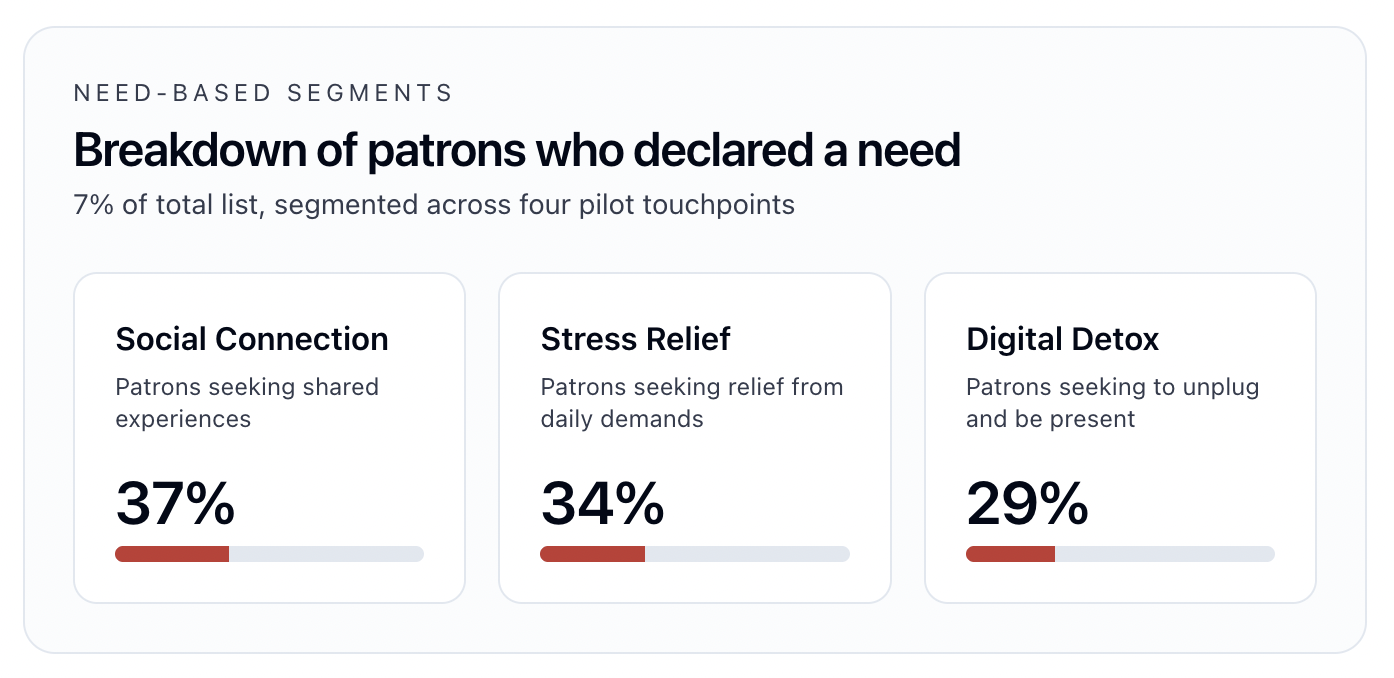
The segments were built from just four touchpoints: three email invitations to the full list, an automated welcome email for new-to-files, and a QR code in one concert program. Every email during the pilot also included a link to the survey. No incentive. Just a well-researched ask and a clear promise to use the information to communicate more effectively.
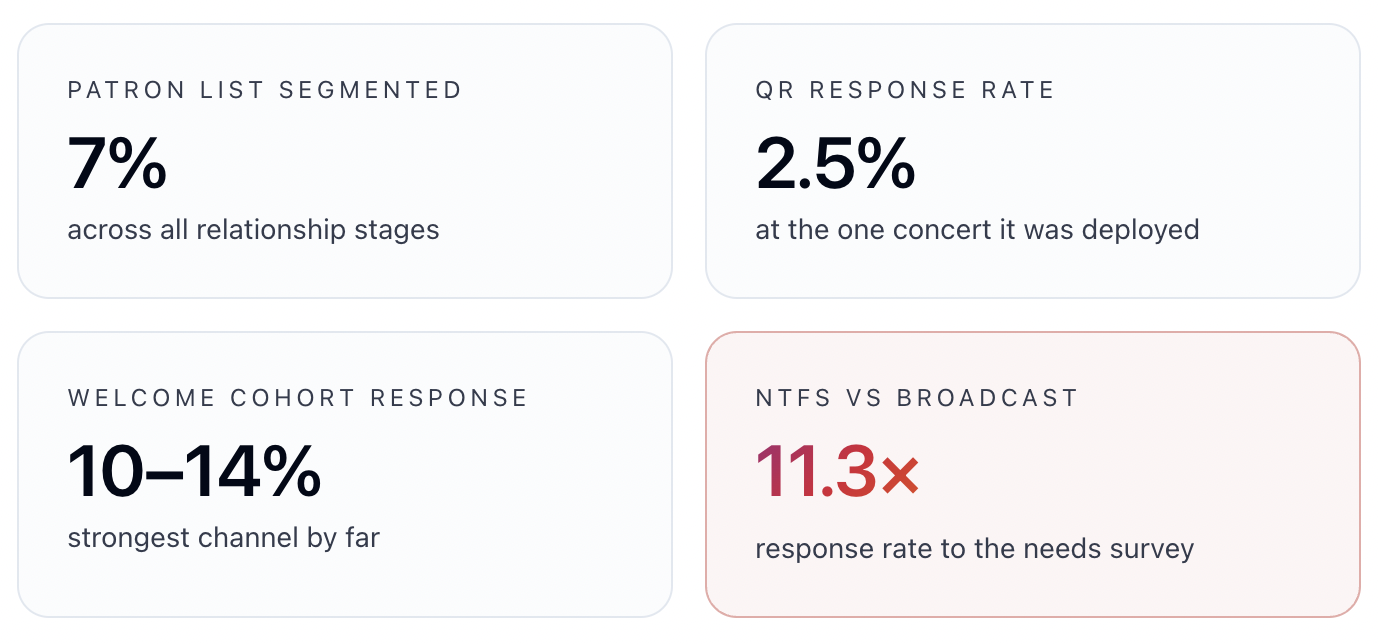
The survey performed best when asked shortly after a patron joined the list. 100% of new-to-file need-declarers responded within 7 days of joining — exactly when they were most willing to tell us why they were here and what they were looking for.
This wasn't a full-scale rollout.
Website popups, social media, direct mail, SMS, and Cindr's in-venue kiosk were never activated during the pilot. Based on the response rates we observed, a conservative projection puts coverage at roughly 14% by end of year two and 21% by end of year three — before any of those channels come online.
How the pilot was structured.
Four concert cycles. Same concerts, same windows, same cadence. The only difference was the messaging.
We ran a side-by-side test across four concert cycles, January through May 2026.
Need-based group: personalized messaging, each email framed through the lens of what that patron told us they needed.
Control group: standard broadcast emails — the same kind of concert announcements NBSO had always sent.
Both groups received emails about the same concerts, in the same send windows, at the same cadence. Subscribers and current ticket holders were excluded from both groups. Attribution used a 7-day, last-touch, email-only conversion window.
The control group received stand-alone broadcast announcements. The need-based group received a five-stage funnel designed to move a patron from awareness to purchase, one step at a time—demand-side thinking, operationalized.
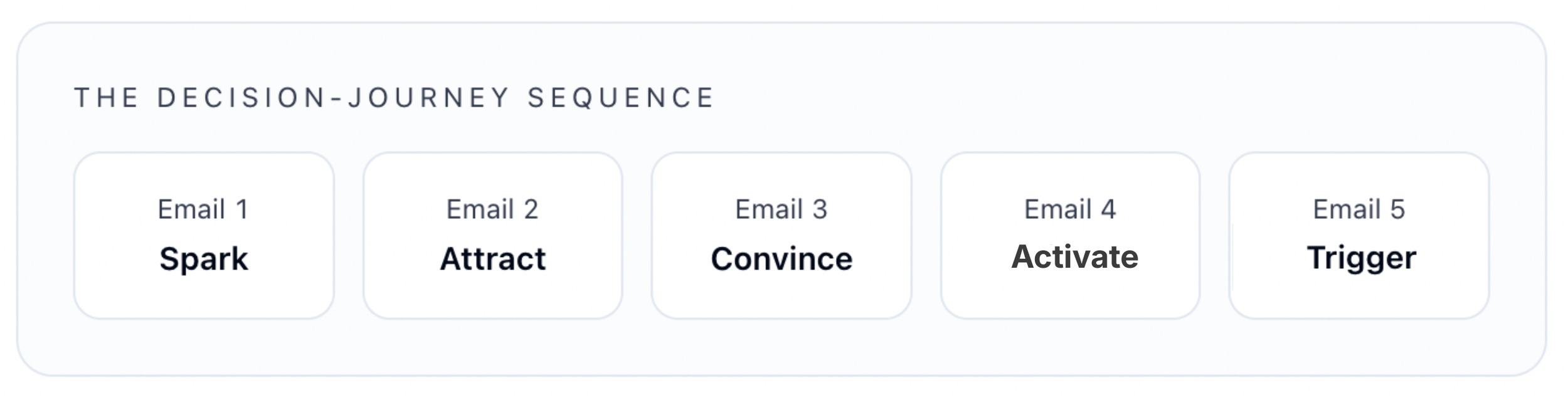
Each email had a different job.
A five-stage sequence built around the patron's decision journey.
The emails that drove the results broke nearly every rule in traditional arts marketing. Text-based. No images. Just a logo at the top and black text on a white background — like a letter from one person to another.
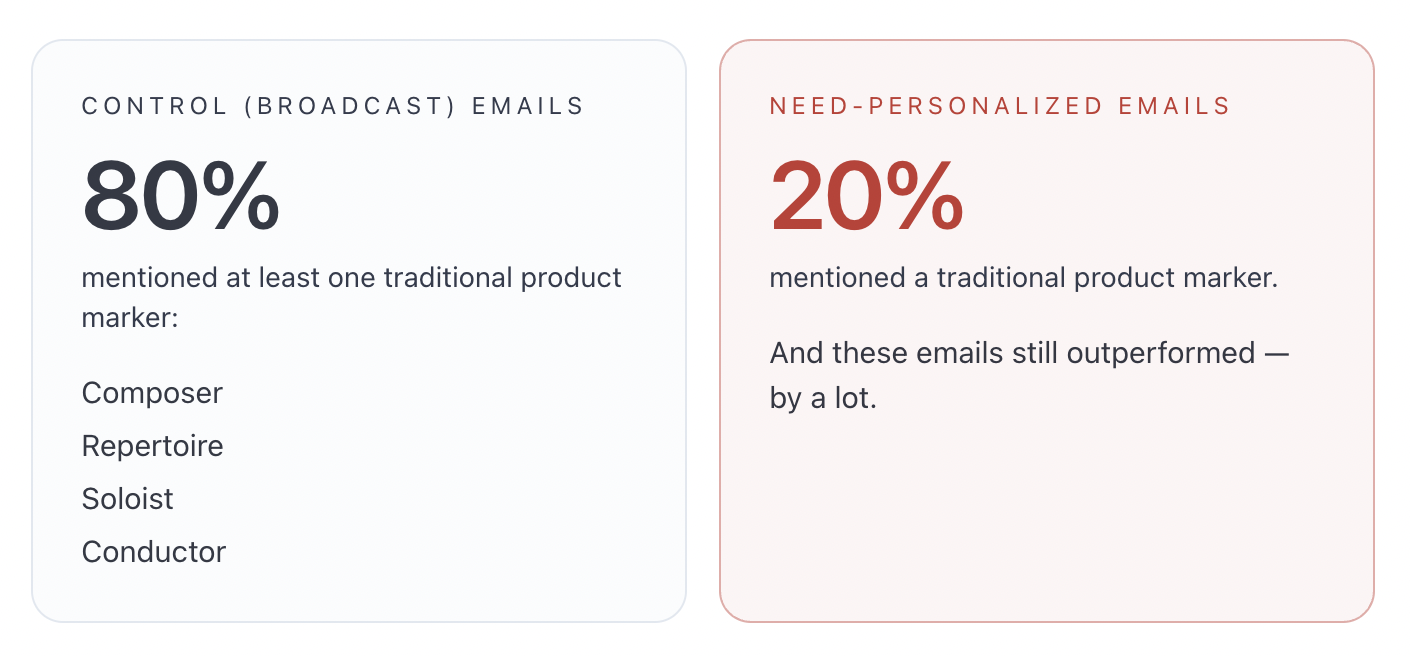
An email that acknowledges the human on the other side is itself a delivery of value.
For a person who feels unseen in daily life, that acknowledgment matters. The organization has already begun delivering on its value proposition — just by asking the right question and reflecting it back. That's something a demographic segment or a ticket history can never produce. The result is what we call relevance at scale.
Spark: making the reader feel seen.
Attract: helping them imagine themselves there, and what could change for them.
Convince: providing proof the experience delivers.
Trigger: removing uncertainty.
Urgency: actively pushing for the purchase.
Most arts campaigns try to sell tickets to patrons at the bottom of the funnel — your loyal core. This sequence was different. Each email did a different job to move the patron through their decision journey toward the purchase.
The biggest conversion lifts weren't generated by urgency. They came from the middle of the funnel.
We often assume the bottleneck is awareness or urgency. The pilot data suggests the bottleneck may actually be belief — that the experience will actually deliver what they need.
Landing pages and measured impact.
Personalized landing pages carried the relevance forward.
Starting with the March concert, every click from a personalized email landed on a personalized landing page — one per segment, built in Cindr. Same concert. Three completely different value propositions. The email created the doorway in. The landing page connected the need to the actual concert experience.
The post-event microsurvey
The email funnel got patrons to the concert. A post-event microsurvey told us what they experienced. Not a satisfaction survey — two questions on a simple emoji scale: How did you feel before you came tonight? How did you feel when you left? Patrons rated energy, mental wellbeing, and sense of community, then had the option to share a testimonial.
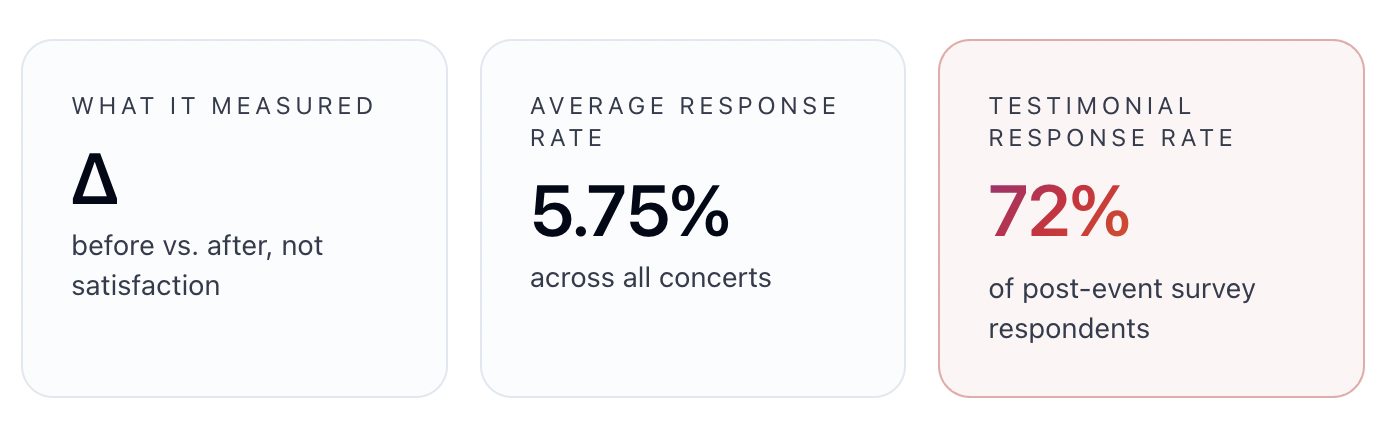
From those two questions we did two things: assigned an impact score for every respondent, and calculated aggregate impact across the entire audience. The typical satisfaction score tells you if someone liked the experience. The delta tells you if it actually worked — how much more energy, connection, or calm the patron left with.
On average, NBSO patrons walked away with 23% more energy, 20% improvement in mental wellbeing, and 18% more connection and belonging.
When impact is quantified like this, the case for support in grant applications, donor appeals, and even board reports is much more persuasive.
Plus, testimonials and aggregate impact can feed directly back into the email funnels — to use as social proof in Attract and Convince stage emails for subsequent concerts.
The full flywheel in motion
Patron declares a need
Personalized email speaks their language
Landing page keeps the promise
The concert delivers the outcome
Post-event survey measures the impact
Impact data fuels the next campaign and the next ask
And the cycle compounds.
2.9× ticket conversions.
Need-segmented patrons converted at nearly three times the rate of the control group — and the lift persisted across all four cycles.
During the pilot, need-segmented emails outperformed broadcast emails on opens and clicks, with the unsubscribe rate unchanged (and already very low). The number that really matters here is conversions.
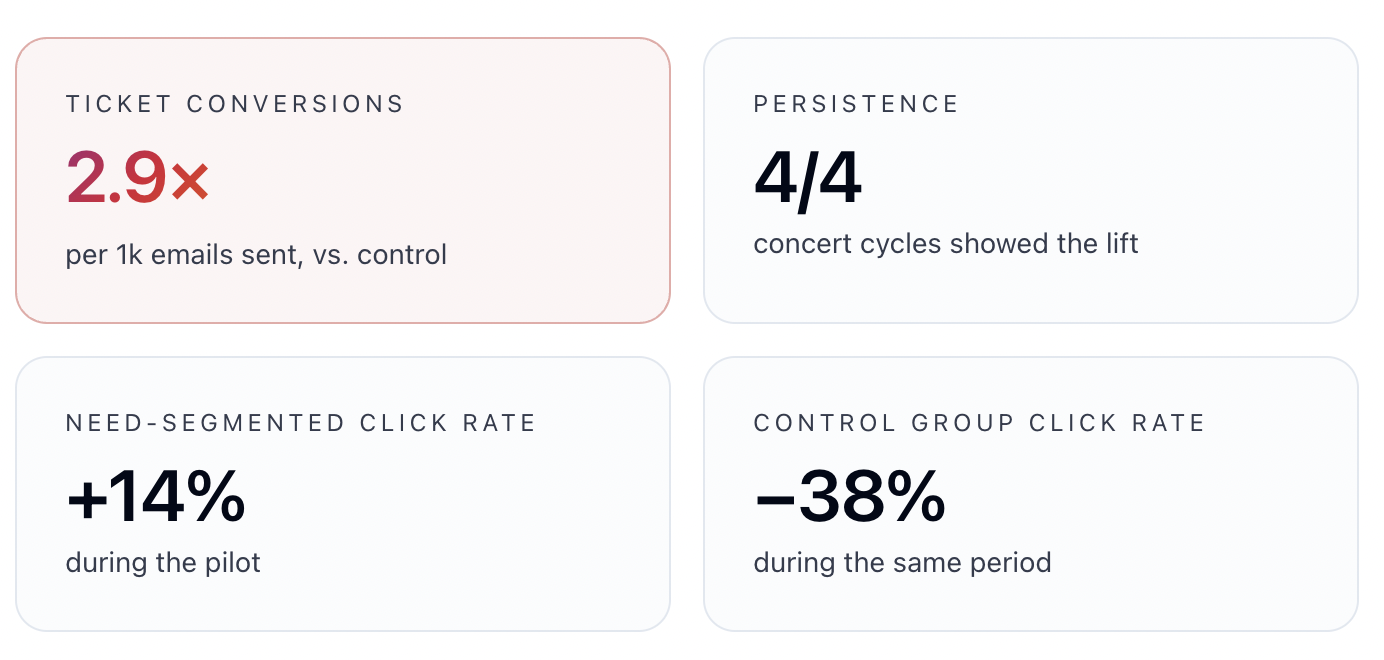
After normalizing to tickets sold per 1,000 emails sent, every ticket the traditional emails sold, the need-based emails sold nearly three.
Were these already your most engaged patrons?
We checked. Yes, need-segmented patrons were already more engaged before the pilot — but during the pilot they engaged even more. Their click rate rose 14% while the control group declined 38%. Open rates rose 6%.
We also checked whether these were simply habitual buyers. Among need-segmented buyers already on file before the pilot, only 39% had purchased during the same Jan–May window in 2025. Those same patrons generated 3.3× more purchases and ~3.6× more revenue during the pilot than they did one year earlier.
Need-segmented patrons were excluded from the control cohort's pre-pilot calculations to confirm that the control group's decline reflected real behavioral change — not simply the removal of highly engaged patrons from the pool.
The concert that should have struggled.
Lowest-attended concert of the pilot — and the largest need-based lift. Audience resistance may be a messaging problem, not a demand problem.
The March concert wasn’t expected to do well. The music director had programmed an Avner Dorman percussion concerto and a Charles Ives symphony — the kind of program that gives marketing directors heartburn.
As predicted, it ended up being the lowest-attended concert of the four, roughly 20% below the pilot's average attendance. And yet:
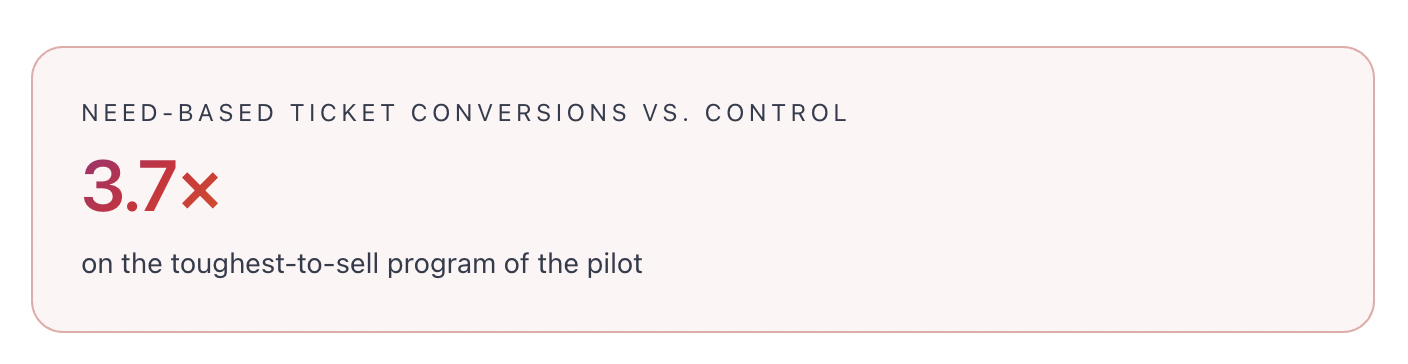
The need-based cohort bought tickets at 3.7x the rate of the control group. Same concert. Different doorway in.
The lesson: Perhaps the problem isn’t demand — but messaging.
Newer patrons leaned in hardest.
New-to-file patrons who declared a need purchased at 2.4× the rate of those who didn't — and made their first purchase 10 days sooner.
One of the most striking findings came from our newest patrons. Among the nearly 900 new-to-file patrons who joined the list during the pilot, those who declared a need behaved very differently from those who didn't.
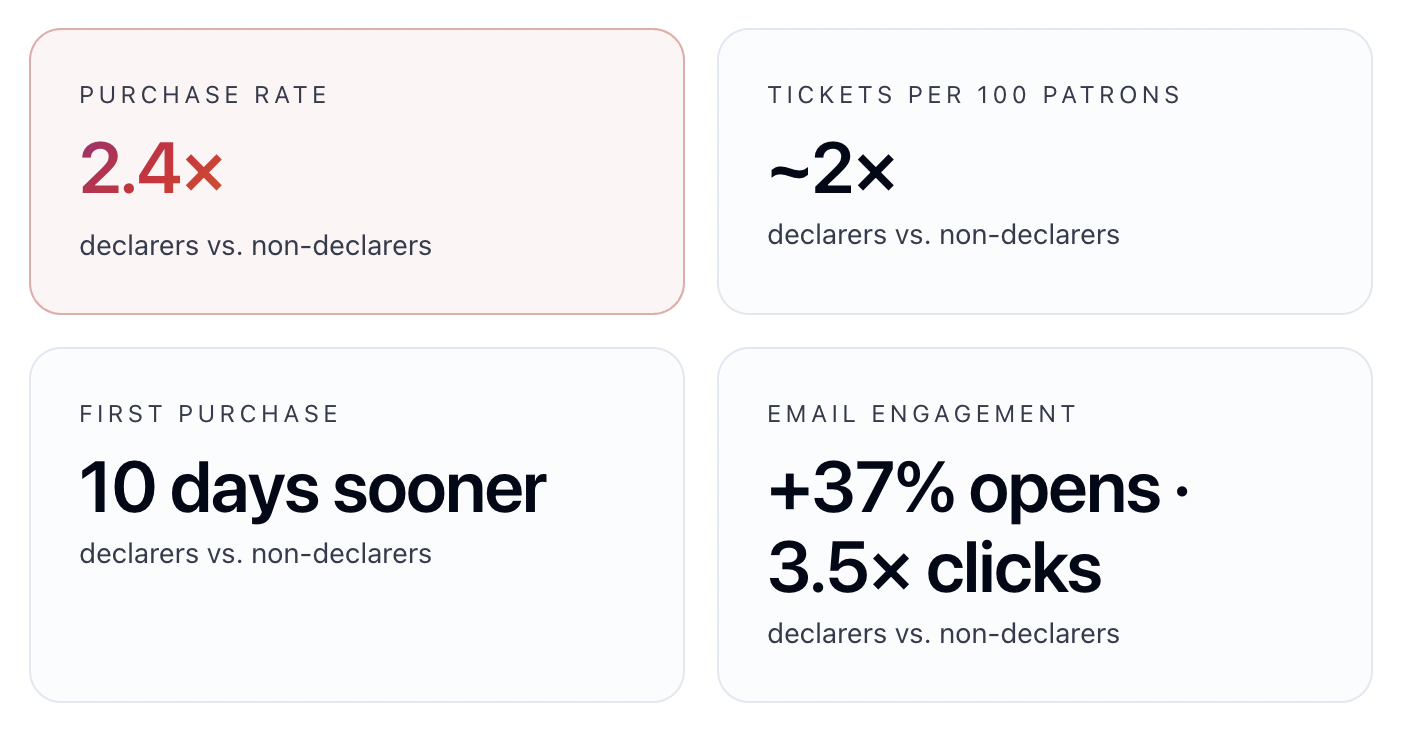
NTFs completed the needs survey at 11.3x the rate of existing patrons, and 100% of NTF declarers did so within 7 days of joining the list.
Need declaration appears to identify something important — very early in the relationship — about how engaged the patron will be in the future.
What's next.
7% coverage was an early test, not a full rollout. The most interesting question is what happens when this becomes a core organizational capability.
The pilot started with one question: can need-based intelligence increase engagement and drive higher ticket sales?
The answer was yes — across every metric we measured, with just 7% of the audience segmented by need.
THE PILOT AT A GLANCE
2.9× more ticket conversions than the control group
Lift persisted across all four concert cycles
3.7× lift on the toughest-to-sell program
NTF declarers purchased at 2.4× the rate of non-declarers
Returning buyers generated 3.3× more purchases and ~3.6× more revenue vs. a year earlier
Unsubscribe rate unchanged (already very low)
This wasn't a full rollout. It was an early test.
Which means the most interesting question isn't what happened during the pilot. It's what happens when this moves from a small controlled test to a core organizational capability.
Reflections from the team

Dave Prentiss, President & CEO: "The short answer is [this pilot] was a success. I think it passes the test. We've seen enough promising results already to make us want to continue this...I see this as strengthening the case statement, so to speak...I think it's going to help us all the areas that we need to be a flourishing arts organization."
"In a way, the fact that a lot of people don't really know much about classical music now might be to our advantage. Because it's a clean slate and we can tell in a different way what classical music can be. This approach is perfect, because we're not starting with the art, we're starting with 'What do you need?' And there's a good chance that classical music might fit into that. So by leading with the demand side of things, it's like a new beginning for classical music and for other arts too...I view it as expansive rather than reductive. The demand side was always there. We are just revealing it more clearly."

Conee Sousa, Director of Marketing & PR: "I'm curious to see whether people will come back more often and engage more deeply over time, like purchasing subscriptions instead of individual concert tickets. And I'm interested in whether this works to bring in more new people with things like changing our digital ads from 'You need an orchestra concert in your life' to 'Do you need stress relief? This can help.'"'
Ready to see what this looks like for your organization?
Run this same pilot at your organization — same playbook, same segmentation logic, same measurement framework. You bring the audience. Cindr handles the rest.
