
Oracle saved the Nashville Symphony’s season. Now comes the harder part.
Last week, the Nashville Symphony announced that it was suspending the remainder of its 2026/27 season and furloughing its musicians and full-time staff.
Then, six days later, Oracle stepped in with $10 million.
Just like that, the season is back on. The furloughs will not happen. Musicians will keep playing. Staff will keep working.
It’s an extraordinary intervention. It also doesn’t solve the Nashville Symphony’s biggest problem.
The Symphony itself said as much. In its October 4 letter to patrons, new president and CEO Mark Tillinger wrote that Oracle’s gift gives the organization “time and momentum” to address its “longer-term financial challenges.” He named the work ahead plainly: restructuring operations, bringing costs and revenue into balance, and strengthening the institution’s financial foundation.
One urgent problem has been solved—but there’s a much bigger hurdle up next: driving significant organizational change.
And new information suggests just how complicated that work will be.
In an interview with the Nashville Business Journal this week, Tillinger described an organization with both a revenue problem and an expense problem. He identified post-pandemic audience decline as “a major driving factor” in the crisis. He said restructuring would begin by examining ways to maximize revenue, then determining the size and structure of the organization that revenue can sustainably support.
And he named another problem: trust.
“Without a doubt, on Monday, we damaged the trust that our donation partners had in us, that our musicians had in us and that our staff had in us, and the city,” Tillinger said.
Across Facebook, Reddit, and article comments, prescriptions abound for what the Symphony should do next:
Build a $100 million endowment.
Get Taylor Swift to step in.
Cut executive compensation.
Increase public funding.
Shrink the orchestra.
Establish a trolley to shuttle patrons from parking to the venue.
To name just a few.
Each of those prescriptions reflects an assumption about what is driving the Symphony's problems—and therefore what needs to change. Before choosing among them, the leadership team will need to distinguish between symptoms and their underlying causes.
Because knowing what went wrong doesn't necessarily tell you why it went wrong—or what will fix it.
The Hard Part
But understanding the causes and deciding what to do about them is only part of the challenge.
The Symphony still has to get an organization full of people with different priorities, experiences, and beliefs to move forward together.
That raises another critical question: Which managerial tools are most likely to move a struggling organization forward?
That’s the problem Clayton Christensen, Matt Marx, and Howard Stevenson address in their Harvard Business Review article “Tools of Cooperation and Change.”
Their answer: it depends. To what extent do people agree about what they want? And to what extent do they agree about what will get them there?
Christensen, Marx, and Stevenson argue that the answers to those two questions can tell leaders which managerial tools are most likely to drive change.
They call it the Agreement Matrix.
Four Categories of Managerial Tools
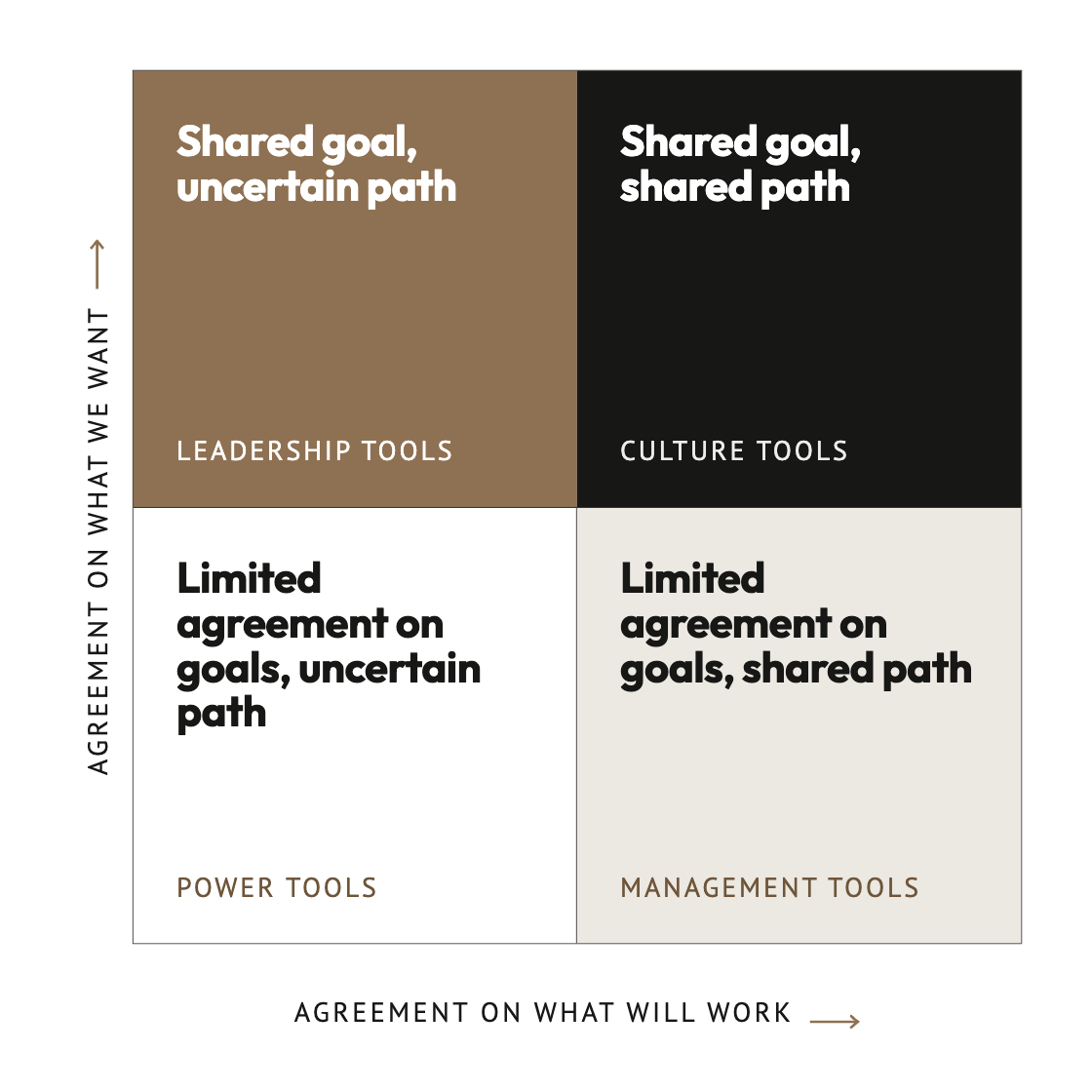
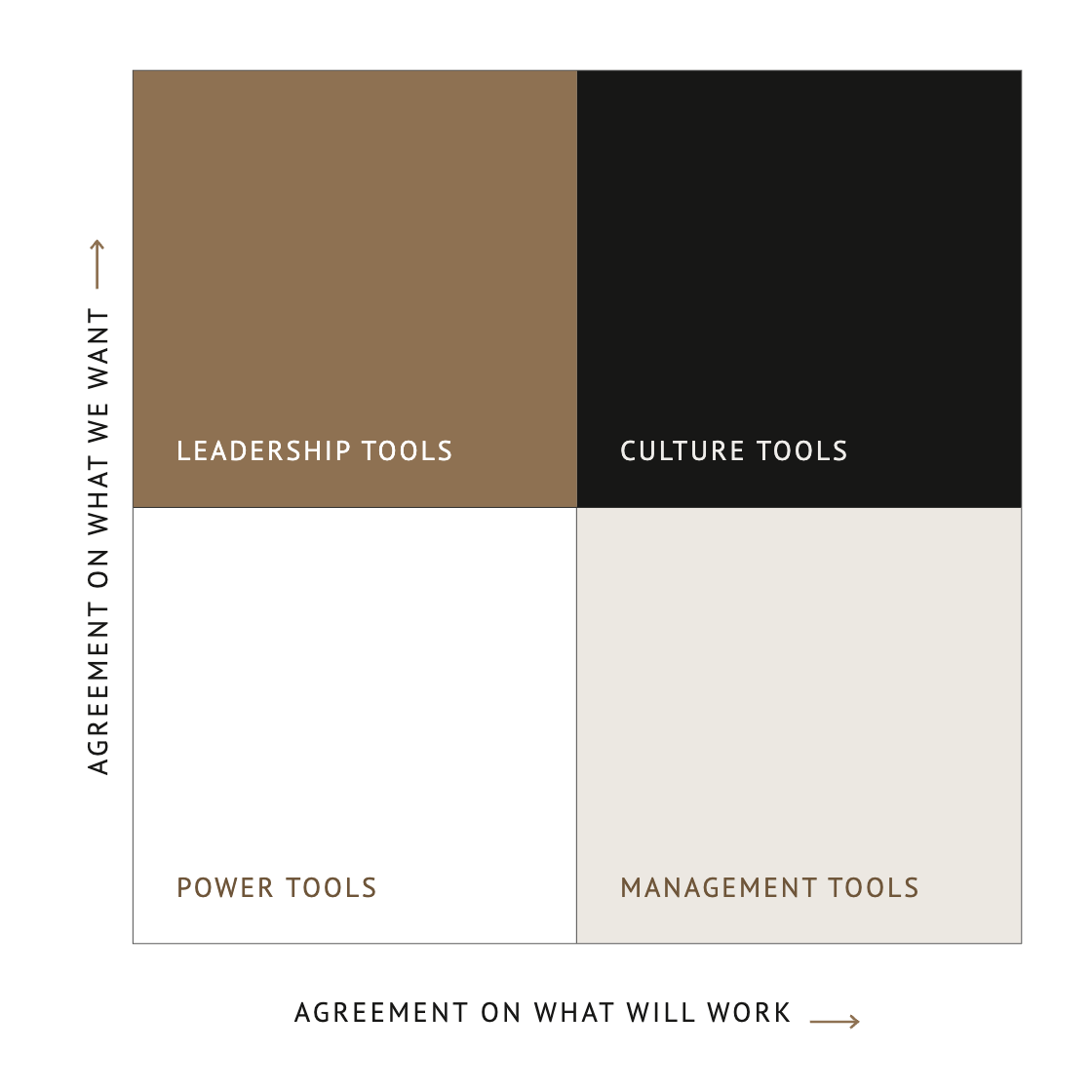
The matrix identifies four broad categories of managerial tools: power, management, leadership, and culture.
Power tools use authority to compel action. They are most applicable when agreement is low about both what people want and what will work.
Management tools use things like training, measurement, and standard procedures to coordinate action. They work when people agree about what will work, even if they don't necessarily want the same things.
Leadership tools use vision and charisma to help people move toward a shared goal. They work when people agree about what they want, but agreement is low about how to get there.
Culture tools use rituals, traditions, and shared ways of working to reinforce behaviors that have proven successful over time. They work when agreement is high about both what people want and what will work.
But even familiar managerial tools can fail when the conditions aren't right.
Take strategic planning.
Christensen, Marx, and Stevenson argue that a strategic plan may help leaders determine where they believe an organization should go. But if the people expected to carry it out do not agree with its underlying premises, the plan itself is unlikely to produce cooperation.
Or vision.
Vision can be powerful when people already agree about what they are trying to accomplish, even when they don't yet agree about how to get there. Without agreement about the goal itself, an inspiring vision is unlikely to change much, “aside from inducing a collective rolling of eyes.”
The tool has to fit the situation.
Two Questions for the Nashville Symphony
So where is the Nashville Symphony on the matrix? What tools are the best fit for its situation? That's something Tillinger and his team need to determine.
How much agreement exists about what a sustainable Nashville Symphony should look like?
The board, executive leadership, musicians, staff, donors, and other stakeholders may readily agree that the Symphony should survive and thrive. But agreement gets harder when priorities require tradeoffs. How important is maintaining the current size of the orchestra? The number and type of performances? Musician and staff compensation? Accessibility? Artistic ambition? Investment in audience development? Debt reduction?
And how much agreement exists about what will get them there?
Tillinger has already identified audience decline as a major factor in the crisis and said the organization will look first for opportunities to maximize revenue before determining the size and structure it can sustainably support.
But does everyone agree about what will increase revenue?
Is the path primarily philanthropic? Will programming changes attract new audiences? Is this a pricing, positioning, or audience-development problem? Do the economics require a fundamentally smaller organization?
We don't know.
And that's precisely what Tillinger needs to find out. Before reaching for a strategic plan, a new vision, new procedures—or any other tool for driving change—he needs to understand where agreement already exists and where it doesn't.
This is where Tillinger's acknowledgment of damaged trust becomes especially important.
Christensen, Marx, and Stevenson warn that using tools that don't fit the situation can cost leaders credibility. For a Nashville Symphony leadership team already working to rebuild trust, choosing the wrong tools could therefore carry a cost beyond simply failing to produce change.
Because the Nashville Symphony doesn’t just need a plan. It needs a way to get people to cooperate in carrying one out.
Where does your organization sit on the Agreement Matrix?
I built a simple diagnostic based on Christensen, Marx, and Stevenson's framework to help leaders think through those two questions—and identify which tools of cooperation may fit their situation.
