
The Wrong Trousers: What the Met Opera’s Crisis Reveals About Strategy in the Arts
You cannot repertoire-select your way out of a relevance crisis.
The Met is in the New York Times again, searching for another solution to its financial crisis. This time, they brought in BCG to stabilize their finances through “cost reduction, ticketing and fundraising enhancement.”
But even the smartest consultants in the world can't fix the symptoms of a demand problem using supply-side tactics.
So we shouldn’t be surprised that Boston Consulting Group resorted to a product-focused approach: doubling down on blockbuster works and cutting costs.
Or should we?
BCG’s own research has found that personalization—a proven demand-side strategy—can grow revenue 10 percentage points faster. They quite literally wrote the book on personalization in the age of AI.
So why didn’t they recommend a personalization strategy for the Met?
Instead, BCG generated the same familiar recommendations that have left arts organizations spinning their wheels for decades—strategies grounded in a value proposition that puts the product first, instead of the people they’re meant to serve.
Two Strategies. Same Framework.
The Met has now tested two opposite product strategies in the past half decade. First, Peter Gelb’s “big bet” on contemporary works—new operas, living composers, opening-night premieres.
Most new productions sold between 50–68% of seats. Meanwhile Verdi’s Aida sold 82%.
So they called in Boston Consulting Group. The answer: more La Traviata. More Puccini. Lower costs by consolidating shows.
Opposite strategies. Same product-first framework.
The Met’s audited financial statements reveal the depth of the problem. Their endowment was drawn down by more than $56 million in a single year—far exceeding the institution’s standard 5% spending policy. Box office revenue covers barely a fifth of operating expenses. The average subscriber is 70 years old. Subscription sales have fallen from 45% of ticket revenue in 2000 to just 7% today.
What’s frustrating is that the solution has been hiding in plain sight for years.
The Growth Driver in Today’s World
BCG knows this.
In 2010, McKinsey warned that nonprofits who failed to adopt need-based segmentation would risk wasted marketing dollars, missed growth opportunities, and declining relevance.
When you segment by need, you are much better positioned to create communications that resonate deeply.
Today, we call this need-based personalization. And the research is impossible to ignore: personalization just might be the single most powerful growth lever in the age of AI.
BCG itself has shown that companies doing personalization well grow revenue 10 percentage points faster.
McKinsey has found that personalization drives 10–15% revenue lift on average, with top performers seeing up to 25%.
Plus, 78% of consumers say personalized content makes them more likely to repurchase.
That last stat is worth sitting with for a moment.
78% are more likely to repurchase. In an industry where loyalty is collapsing at every level of the funnel, that number is not a nice-to-have. It is the difference between financial sustainability and crisis.
Research from Deloitte reinforces that of McKinsey and BCG. Companies that personalize are:
48% more likely to exceed their revenue goals
71% more likely to report improved customer loyalty
Personalization is not a nice-to-have. It is the mechanism that grows relevance, revenue, and loyalty.
This is not just about stabilizing finances. It’s also about market share.
BCG has projected that, over the next five years, $2 trillion in revenue will shift toward companies that master personalization. What does this mean for the arts?
The companies that get personalization right (e.g, going beyond first names and behavioral strategies) will capture a disproportionate share of future revenue. The organizations that don't start now are actively ceding ground.
The Product-First Model
So why didn’t BCG recommend personalization?
BCG was hired to optimize the old model. And tactics designed to address symptoms won’t solve the root cause when the model is built to serve itself, not the people it's meant to reach.
Inside a product-first model, every resource, every process, and every incentive is optimized around preserving and promoting the product itself. When audiences don’t respond, the only lever available within that system is to change the product—make it newer, make it more familiar, make it cheaper.
That is why the Met can try contemporary works or Puccini and end up in the same place. It’s not that the leaders are incompetent. Their model was built on an outdated premise in a pre-digital world.
A world where institutions were the arbiters of culture, audiences arrived by habit, and loyalty was assumed. That world is gone.
Today's consumer expects to be understood deeply—and rewards the organizations that do this well.
The Right Question
Instead of asking “how do we get people to care about our product,” the customer-first model asks “what do people need, and how is our art uniquely positioned to meet that need?”
That question requires a different kind of intelligence—not demographic data, not ticket history, but zero-party data: information that people actively choose to share about their needs, in real time.
When brands ask customers to share what they need in exchange for personalized experiences, zero-party completion rates routinely exceed 70%.
Not because people love surveys, but because being genuinely understood feels rare—and valuable.
The arts are extraordinarily well-positioned for this.
Arts experiences deliver measurable outcomes: stress relief, social connection, improved mental wellbeing, a sense of community. These are real needs that a significant portion of the population is actively seeking to meet.
The gap between what arts organizations offer and what non-attending audiences need is not as wide as the attendance numbers suggest.
The gap is in how the offer is framed—and who it’s framed for.
Solving The Relevance Crisis
The Met Opera is one of the greatest performing arts institutions in the world. The issue is not the product. It’s the question their model is built on.
You don't have to rebuild everything at once. You just have to ask the right question—and start building a system to act on the answer.
The technology to do this exists. And it works the way the research says it should—by treating every audience member not as a ticket buyer, but as a human being.
The question is: which arts organizations are brave enough to act?
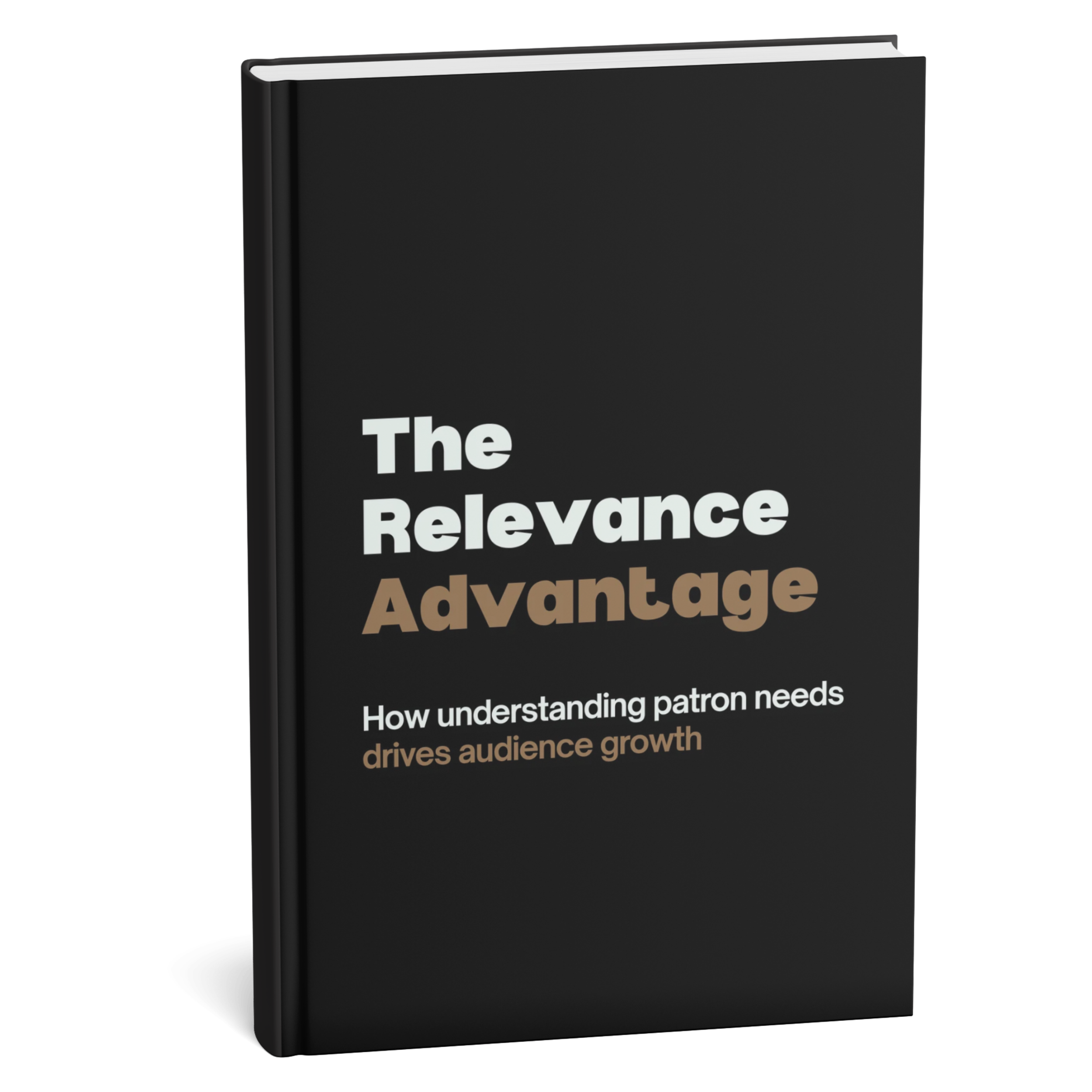
Ready to build the demand-side model?
The Relevance Advantage is a practical guide to turning patron needs into relevance, personalization, and audience growth.
Inside, you’ll learn how to identify need-based segments, collect zero-party data, build personalized campaigns—and see the results of a 16-week orchestra pilot that generated 2.9x higher buyer conversion.
Related posts







Can need-based intelligence increase engagement and drive higher ticket sales? A 16-week controlled test at the New Bedford Symphony.